$9.62 billion of it is procurement, $35.32 billion is RDT&E — and the bill carries the Defense Production Act, Office of Strategic Capital and Industrial Base Analysis and Sustainment lines by name.
02 The Space Force restarted its satellite-control antenna competition around production capacity.SCAR returns as a Commercial Solutions Opening after a $1.7 billion contract cancellation, explicitly scored on manufacturing capacity and supply-chain resilience.
03 Vandenberg SFB posted its own industry day."Spaceport of the Future," registration due 10 July — the most accessible in-state door into West Coast launch infrastructure work this window.
04 NASA priced four lunar lander missions at $590.4 million on the afternoon this issue closed.Astrobotic, Firefly and Intuitive Machines all now have 2028 need-dates and buy cycles expected to start in the near term.
05 NEXUS proposals are due 10 July, and CLPS 2.0's sources-sought notice posted this window.
Notes from the co-founders
An appropriations topline is a headline. The mechanisms underneath it are the business. The bill in these pages carries specific instruments for funding domestic industrial capacity, and a competition rewritten around whether a supplier can build at rate rather than whether a design is elegant.
The stated criteria favor shops with documented capacity and current certifications over those still describing capability in a slide deck. We would rather this cluster sat in the first category. Read the mechanisms, not the topline.
One capability card, from every member company, to Diego F. Padilla at diego@rakarinc.com, by Tuesday, 1 September 2026, 5:00 p.m. PT. One page: certifications held with expiry dates, processes performed in-house, maximum part envelope, current lead time, and one named federal or prime customer you are already qualified to. No brochure, no capabilities deck, no company history.
Cards received before the monthly AMA are reviewed on that call; cards arriving after it are worked in the cycle that follows. They are read against the solicitation language in Standing Watch, and where a relevant and consenting contact exists the cluster offers a named introduction. Cards not received are not matched. That is the entire mechanism.
The $55.5 billion line, and what pays for supplier capacity inside it
A defense appropriations bill that names a dollar figure for the Space Force is rare enough. One that also carries the specific mechanisms for funding domestic industrial capacity is the one a California supplier should read past the topline.
The number that will get quoted is $1.072 trillion. The number that matters to a machine shop, molder or harness builder is $9.62 billion, and the paragraph that matters most is the one naming the Defense Production Act, the Office of Strategic Capital and Industrial Base Analysis and Sustainment funding inside the same bill.
Framing figure — Sally Ride
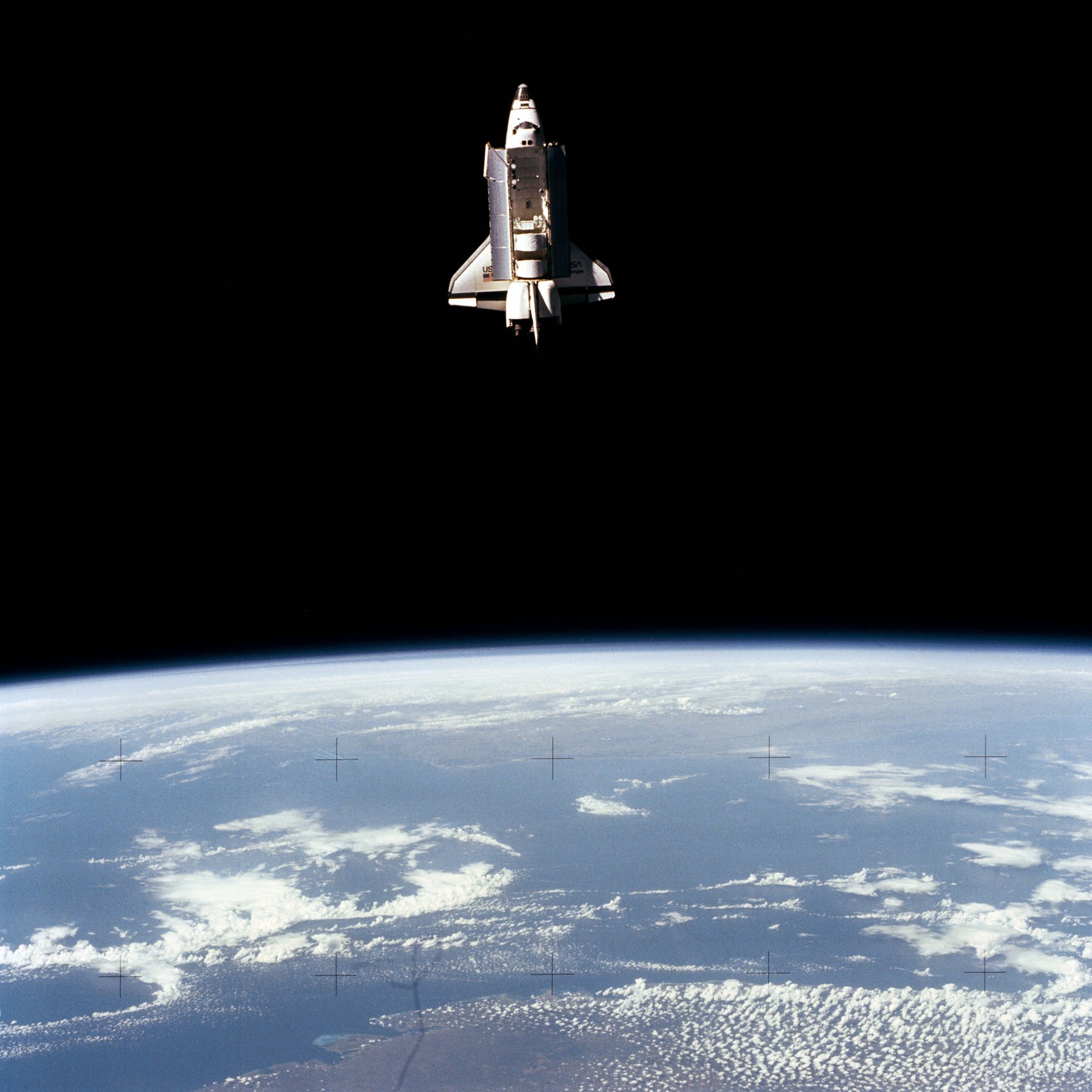
Sally Ride was born in Santa Monica, California, on 26 May 1951 and raised in the Van Nuys and Encino neighbourhoods of the San Fernando Valley, attending Encino Elementary School and Portola Junior High before graduating from Westlake School for Girls in 1968. She earned a Bachelor of Science in physics and a Bachelor of Arts in English literature from Stanford University in 1973, a Master of Science in physics from Stanford in 1975, and a doctorate in physics from Stanford in 1978, researching the interaction of X-rays with the interstellar medium. NASA selected her in January 1978 as part of Astronaut Group 8, the first class to include women. On 18 June 1983 she launched aboard Challenger on STS-7, becoming the first American woman in space; the mission deployed two communications satellites and the first Shuttle pallet satellite, SPAS-1, which she retrieved using the robotic arm she had helped develop.
The FY27 Space Force bill: what pays for capacity
The House Appropriations Committee put a number on the Space Force. The same bill names the mechanisms that fund the industrial base underneath it.
One — $55.5 billion, and where it sits
On 24 June 2026 the House Appropriations Committee approved the Fiscal Year 2027 Defense Appropriations Act by a vote of 34 to 27, setting total discretionary defense spending at $1.072 trillion. Inside that bill, the Committee allocated approximately $55.5 billion for the Space Force.
The breakdown is the part a supplier should read closely: $1.78 billion in military personnel, $8.80 billion in operations and maintenance, $9.62 billion in procurement, and $35.32 billion in research, development, test and evaluation. RDT&E dominates the total, which is consistent with a service still standing up new satellite and launch programs rather than buying at production rate across the board — but the $9.62 billion procurement line is where fabricated hardware orders convert fastest into subcontract flow.
The $55.5 billion figure excludes a further roughly $12 billion the administration had sought for the Space Force through a separate budget reconciliation package. That reconciliation money is not yet appropriated. Suppliers should treat the $55.5 billion as a committee-approved proposal and the additional $12 billion as a separate, uncommitted request.
Two — the lines that fund domestic capacity by name
The bill carries more than $2.9 billion combined for the Defense Production Act, the Office of Strategic Capital, and Industrial Base Analysis and Sustainment. These three programs are the vehicles Congress uses specifically to expand and de-risk domestic manufacturing capacity, as distinct from buying finished end items. A California AS9100-D shop, molder or casting house evaluating where to spend business-development effort should treat this line, not the topline $1.072 trillion, as the more direct signal: it is money set aside to fund supplier capacity itself.
The bill also provides $836 million to procure new-entrant low-cost munition systems for the first time, with multiyear procurement authority, and directs more than $7.5 billion toward hypersonic weapons and associated test infrastructure — both categories that pull on precision machining, high-temperature alloys and test-fixture fabrication, even where the prime contract itself sits outside the space portfolio.
This is a Committee-level markup, not an enacted law. It must still clear full House passage, Senate action and reconciliation between chambers before funds are available to obligate. Suppliers should track it as a strong forward signal on program priorities, not as money on contract as of 30 June 2026.
Three — the Space Force rewrote a competition around capacity, not just design
On 24 June 2026 the Space Force restarted its Satellite Communication Augmentation Resource antenna competition, known as SCAR, after cancelling a $1.7 billion AeroVironment contract. The restart runs through the Rapid Capabilities Office as a pre-solicitation for electronically steered phased-array antennas, with a Commercial Solutions Opening as the first procurement step.
What distinguishes this restart from a routine re-compete is the explicit scoring criteria: the competition is written to emphasise manufacturing capacity, supply-chain resilience and fixed-price production, not only technical design merit. That is a rare instance of a procurement instrument built around the question a mid-tier manufacturer is best positioned to answer — can you build it at rate, on schedule, at a fixed price — rather than around novel engineering. Companies that build phased-array antenna structures, RF enclosures or precision waveguide components should treat the forthcoming Commercial Solutions Opening notice as a near-term watch item.
Four — Vandenberg opened its own front door
On 26 June 2026, Space Launch Delta 30 posted a special notice for "SLD 30 Spaceport of the Future — Industry Day 2026" at Vandenberg Space Force Base, with registration due 10 July 2026. Industry days of this kind are a relatively direct public entry point for a supplier without an existing Vandenberg relationship to reach the office that manages West Coast polar-orbit launch infrastructure, range operations and installation services.
Five — CLPS 2.0 opened its sources-sought stage as lunar lander money moved
NASA Johnson opened CLPS 2.0, the follow-on Commercial Lunar Payload Services vehicle, with a sources-sought notice under 80JSC026CLPS2 on 5 January 2026, and released the final request for proposals, solicitation 80JSC026R0015, on 15 May 2026, amended twice by 25 June. Proposals were due 30 June 2026 at 1:00 p.m. Central — the day this issue went out. Correction, printed 4 August 2026: this paragraph previously stated that no formal solicitation or proposal deadline had been published as of 30 June 2026. That was wrong. The final RFP had been on the record since 15 May and closed the same day this issue was published. On 30 June, the same week, NASA announced $590.4 million in new robotic lunar lander task orders under the current CLPS program: Astrobotic, two Peregrine flights, $297.9 million; Firefly, one Blue Ghost mission, $144.2 million; Intuitive Machines, one Nova-C mission, $148.3 million, split between a $68.6 million base and a $79.7 million performance incentive. All three missions are scheduled for late 2028, which points to sourcing of tanks, valves, landing-gear structures and thermal hardware beginning in the near term rather than on a multi-year horizon, though the companies' purchasing schedules are not public. Full detail on the capital movement is in Capital Flows below.
Read together, the week's federal signal for a California supplier is consistent: procurement dollars are moving, and at least two of the week's instruments — the DPA/OSC/IBAS lines and the SCAR restart — are explicitly written around the question of who can actually build at capacity, not merely who can design.
FIELD SIGNAL / INDUSTRIAL BASE FUNDING“…every outlay is focused on delivering capability to the warfighter, modernizing our military, revitalizing the defense industrial base, and improving quality of life for those who serve.”
— CHAIRMAN TOM COLE, HOUSE APPROPRIATIONS COMMITTEE · ON THE FY27 DEFENSE APPROPRIATIONS ACT · PRESS RELEASE, 24 JUNE 2026 · HOUSE APPROPRIATIONS COMMITTEE
Teaming Desk
The SCAR restart is the clearest instance this window of a solicitation asking directly for what a mid-tier manufacturer sells. Members who build any of the following should treat the forthcoming Commercial Solutions Opening as a near-term target, not a future one.
Sought — phased-array antenna structures and RF enclosures. Precision machining, environmental sealing and dimensional stability for electronically steered array housings.
Sought — fixed-price production capacity, demonstrated. SCAR is explicitly scored on manufacturing capacity and supply-chain resilience. A documented production-rate history is now a competitive input, not background material.
Sought — CLPS-class lander hardware. Tanks, valves, landing-gear structures and thermal hardware for the Astrobotic, Firefly and Intuitive Machines task orders named in Capital Flows below.
Sought — Defense Production Act Title III capacity partners. The FY27 bill's $2.9 billion combined DPA/OSC/IBAS line is the funding mechanism; suppliers with a specific capacity-expansion case should be preparing it now, ahead of enactment.
·Offered — flight-test, rocket-engine test and horizontal-launch site access. See the member profile below.
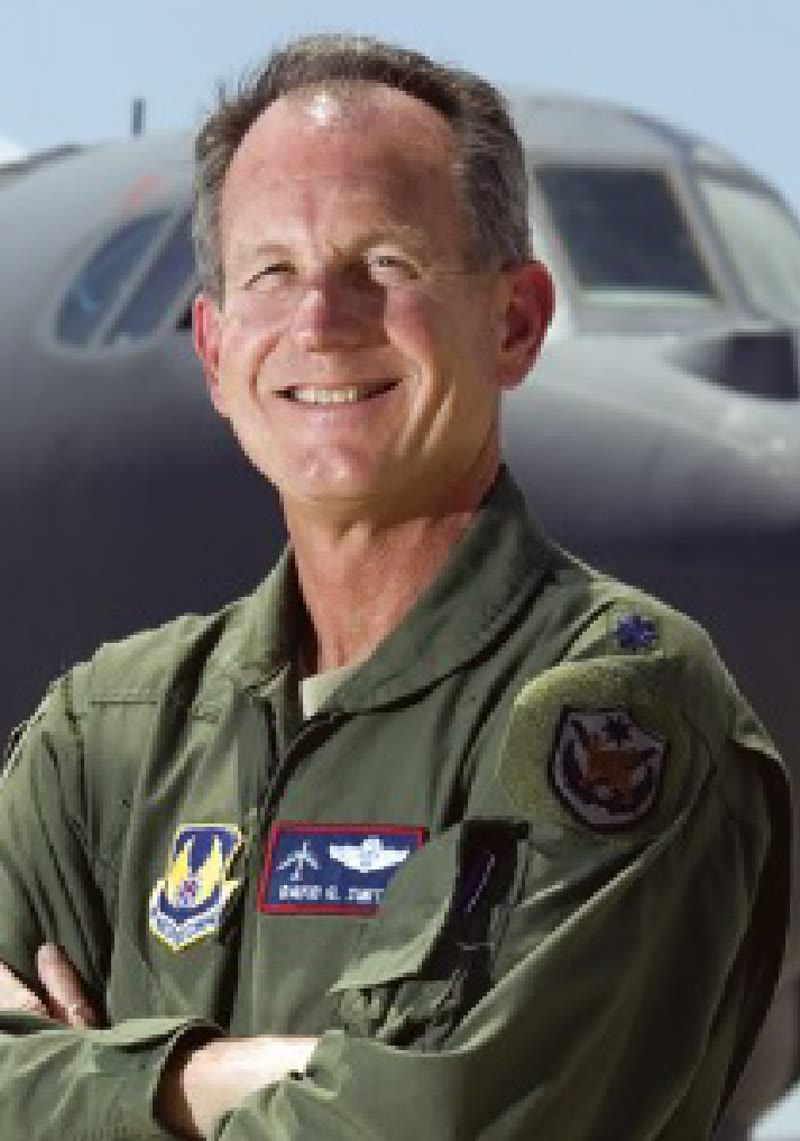
Mojave Air and Space Port at Rutan Field
FAA-licensed civilian aerospace test center and horizontal-launch spaceport at 1434 Flight Line, Mojave, CA 93501, administered by the East Kern Airport District, a California special district formed in February 1972.
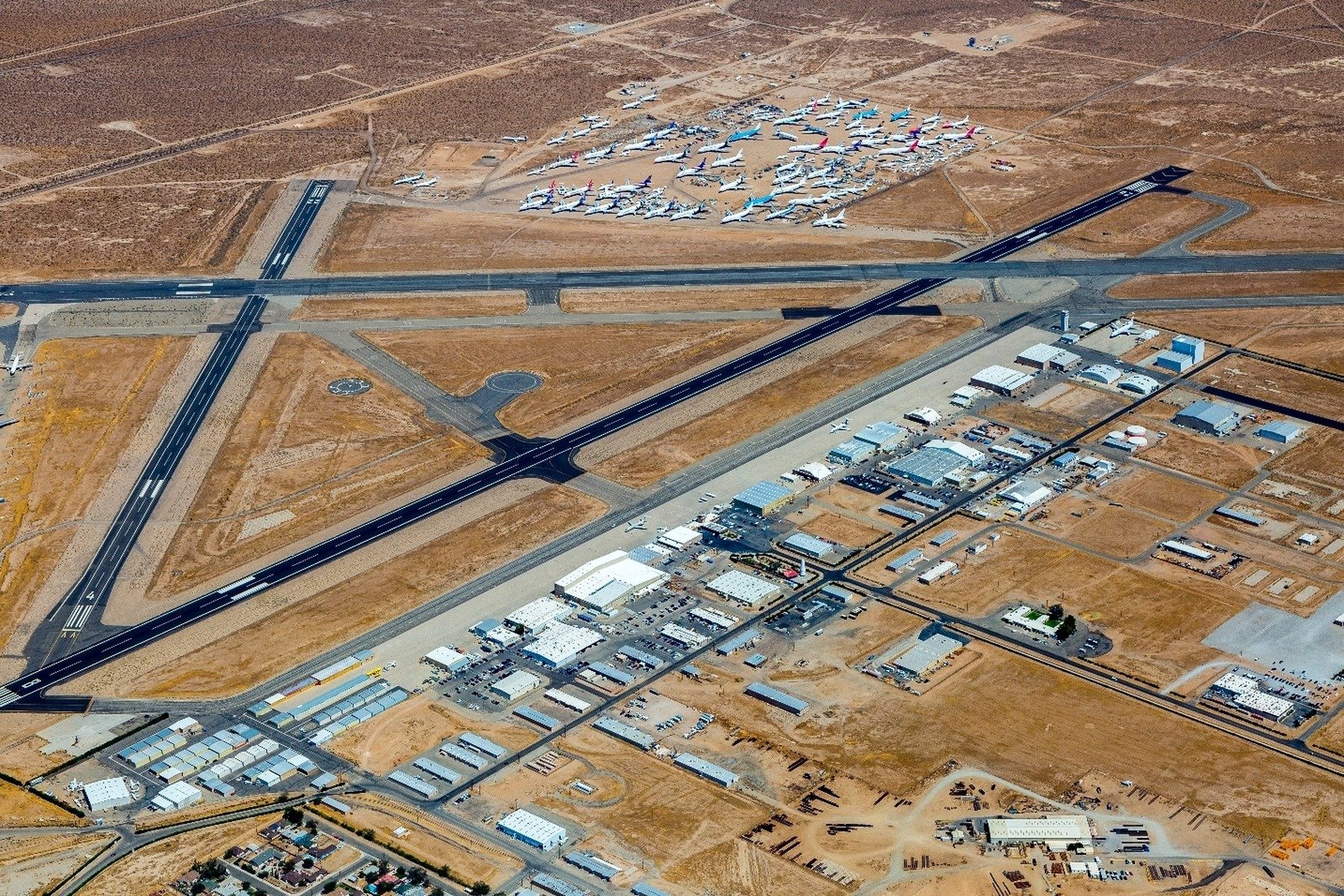
Mojave Air and Space Port at Rutan Field is administered by the East Kern Airport District, formed in February 1972; the airfield itself first opened in 1935, was taken over as USMC Marine Corps Auxiliary Air Station Mojave in July 1942, and passed to Kern County ownership in 1961. The FAA records the site at 1434 Flight Line, Mojave, CA 93501, and lists an active Launch Site Operator Licence, LSO 04-009, issued June 16, 2019, renewed effective June 12, 2024 and expiring June 16, 2029. The property covers more than 3,300 acres and hosts over 60 companies, alongside the National Test Pilot School and a Progress Rail full-service railcar wheel shop that handles 34 railcar shipments a day. Infrastructure comprises three runways—12,500 × 200 ft, 7,049 × 100 ft and 4,745 × 60 ft—dedicated rocket-engine test sites, and access to the R-2508/R-2515 restricted military airspace complex. No quality-management or set-aside certification is stated in the public record; the FAA launch license stands as the site’s principal credential.
On April 6, 2026, the Board of Directors’ agenda approved Stratolaunch LLC as subtenant of Hangar 161 under the National Test Pilot School’s ground lease, which runs to March 31, 2058, extending facilities for Stratolaunch’s hypersonic flight-technology operations. The same agenda carried an Aircraft Rescue and Fire Fighting services item valued at US$830,040 in year one, comprising US$75,000 in mobilisation and US$755,040 in weekly service payments. Separately in 2026, Stratolaunch’s Roc—the world’s largest aircraft by wingspan, at 385 ft with six engines and a maximum take-off weight of 1.3 million lb, based at Mojave—performed two take-offs and two landings over a Porsche Cayenne Electric in a jet-blast demonstration at the spaceport; the source carries a 2026 publication date but no specific in-text date for the demonstration.
Mojave is the site where flight-test, propulsion-test and airframe-integration capacity physically sits within the cluster; its contribution is measured in acreage, runway length and licensing rather than in machine hours. A tenant roster of more than 60 companies, and the addition of hangar space for Stratolaunch in April 2026, mark ongoing test-program demand at the field. The National Test Pilot School’s ground lease, under which the Stratolaunch subtenancy sits, runs to March 31, 2058, indicating a long planning horizon for flight-test occupancy at the port rather than a short-term arrangement.
Capital Flows
Where committed federal money and corporate capital moved in the week of 24–30 June 2026, and what it buys downstream.
Bars are proportional. The Rocket Lab acquisition of Iridium is an announced transaction value, not obligated federal money; the Space Force lines are committee-level FY27 figures, not enacted appropriations. Only the CLPS task orders are contracted money.
NASA's 30 June announcement of $590.4 million in robotic lunar lander missions is the most immediately actionable capital event of the week for a hardware supplier. Astrobotic was awarded $297.9 million for two Peregrine flights, Firefly $144.2 million for a Blue Ghost mission, and Intuitive Machines $148.3 million for a Nova-C mission — split between a $68.6 million base and a $79.7 million performance incentive. All three carry late-2028 mission dates, which points to structural, propulsion and thermal hardware sourcing beginning in the near term rather than on a multi-year lead.
On 29 June 2026, Rocket Lab agreed to acquire Iridium Communications for $54.00 per share, a transaction valued at approximately $8 billion, with closing targeted for mid-2027. Rocket Lab is headquartered in Long Beach, California; a vertically integrated satcom operator with an in-state build footprint would, on closing, be a demand signal for Los Angeles-basin structures and integration suppliers over the multi-year horizon the deal implies, though the transaction itself remains subject to closing conditions.
The FY27 Space Force appropriation approved at Committee level on 24 June carries $9.62 billion in procurement and $35.32 billion in RDT&E; the more than $2.9 billion combined Defense Production Act, Office of Strategic Capital and Industrial Base Analysis and Sustainment funding is the more targeted industrial-capacity signal inside that bill, as detailed in the lead article above. None of this is enacted law; it is a Committee-level markup pending full House and Senate action.
Separately, on 29 June 2026, NASA and the Small Business Administration announced a capital partnership using the SBA's Small Business Investment Company program, matching government-guaranteed loans to private capital, with participating funds required to commit at least 60 percent of invested capital to NASA-identified focus areas. "Specialised materials and components" is named as one of seven focus areas, managed through NASA's Office of Strategic Capital — a direct, named financing channel for component manufacturers, distinct from the appropriations process.
Tuesday, 1 September 2026
11:00 AM Pacific · 45 minutes · in person & virtual
Ask Me Anything. Direct engagement with the cluster co-founders on programs, teaming, and the California space supply chain. Open to entrepreneurs, engineers, researchers, and anyone working in or near the space economy.
1680 Universe Cir
Oxnard, California 93033
Cadence · first Tuesday of every month · 11:00 AM Pacific · recurring. Capability cards submitted by 5:00 PM Pacific the day of the call are worked in the cycle that follows. By-Laws & Capability Statement at spacereturn.org.
Build the cluster with us.
SpaceReturn///// the California Space Cluster is a membership body of California space and aerospace manufacturers, operators, test facilities and service providers. Membership enquiries: diego@rakarinc.com.
Linked public record
- Committee Approves FY27 Defense Appropriations Act, 24 June 2026 — House Appropriations Committee
- House Appropriations Committee approves $55.5 billion for the Space Force — SpaceNews, 25 June 2026
- What's Happening in Space Policy, 21–27 June 2026 — SpacePolicyOnline
- Space Force seeks fresh bidders for satellite control antennas — SpaceNews, 24 June 2026
- SLD 30 Spaceport of the Future — Industry Day 2026, special notice — SAM.gov
- CLPS 2.0 sources-sought notice, 25 June 2026 — SAM.gov
- NASA awards more CLPS contracts, 30 June 2026 — SpacePolicyOnline
- NASA awards nearly $600 million in lunar lander missions — SpaceNews, 30 June 2026
- Rocket Lab agrees to acquire Iridium — SpaceNews, 29 June 2026
- NASA / SBA capital partnership listing — SpacePolicyOnline
- NEXUS BAA, Amendments 01 and 02 — SAM.gov
- Sally Ride — Wikipedia (framing figure biographical verification)
- History — Vandenberg Space Force Base — Vandenberg Space Force Base (official)
- Vandenberg Space Force Base — Wikipedia (county and location verification)
Member profile — Mojave Air and Space Port
Method & colophon
Figures are drawn from primary records wherever a primary record exists — a solicitation notice, an appropriations document, a regulatory filing or an official release — and from identified secondary reporting where one does not. Every source is linked in the column alongside. Where two sources disagree, the disagreement is printed rather than resolved silently. Conclusions the record does not itself state are hedged, or marked as cluster assessment.
- Published by
- SpaceReturn///// The California Space Cluster
- Co-publishers
- Theresa Padilla-Chaparro · Diego Padilla
- Compiled from
- Primary records and identified reporting, linked alongside
- Member contributions
- None in this issue — submissions welcome
- Corrections
- info@spacereturn.org
- Dateline
- Saturday, 27 June 2026 · Oxnard, California
Use this briefing.
Forward it to one supplier who is not yet a member.
Member capability card. Standing module. Members may submit or update a capability card at any time; the one-page format set out above is the current standard.
Mailing address: *|LIST:ADDRESS|*
The Space Observer and its contents are sponsored by Rakar, Incorporated. To place advertising or sponsor a section, contact marketing@rakarinc.com. Public-record items are linked to open agency or publisher postings. Member-private items require express permission before publication. This briefing is informational only and is not legal, investment, export-control or procurement advice; verify all deadlines, eligibility and solicitation terms with the issuing authority before acting. © 2026 SpaceReturn///// The California Space Cluster.